(a) Production systems
AI Production Systems for Animation, VFX & Games
Vertex Theory helps studios modernize CG production with artist-first automation, intelligent orchestration, and human-in-the-loop AI.
Increase output without giving up artistic control.
Find the opportunity. Prove the workflow. Deploy it safely.
(b) Artist-first design
Built for artists, not engineers.
AI and automation only create value when the people doing the work actually want to use them.
Vertex Theory designs systems around artists—with intuitive interfaces, visible feedback, editable results, and human decision points wherever taste, quality, or creative direction matter.
The complexity stays behind the scenes.
Intuitive by default
Tools should feel obvious to the artist using them.
Artists stay in control
AI handles repetition, analysis, and coordination. Artists make the creative calls.
Visible, editable results
Users should understand what happened, why, and what they can change.
(c) Operating model
A new production model
CG pipelines are already highly automated. The opportunity now is to make them more adaptive.
Much of today's production infrastructure was built around deterministic tools, fixed rules, linear handoffs, and people coordinating the exceptions.
Vertex Theory adds a new layer—combining proven deterministic systems with AI that can analyze context, coordinate specialized tasks, evaluate results, and iterate, while keeping artists in control of creative and quality decisions.
Deterministic automation
Use conventional code and production systems for repeatable, reliable execution.
Intelligent orchestration
Use specialized AI agents for reasoning, coordination, analysis, and evaluation.
Human judgment
Keep artists and supervisors in control where creative judgment, quality, or production risk matter.
The result is faster iteration, fewer manual handoffs, and more creative output from the team you already have.
(d) How we engage
Assess
Find the highest-value opportunities.
We work with supervisors, artists, technical directors, and pipeline teams to understand where production friction actually lives. We're not looking for places to force AI into the pipeline—we're looking for the best way to improve the workflow. Sometimes that means process change, sometimes traditional automation, sometimes AI, and often a combination.
Prototype
Prove the workflow before committing to a large build.
We prototype new production patterns around real tasks—combining deterministic tooling, specialized AI systems, automated evaluation, and human review. Each proof of concept is built around clear inputs, outputs, validation criteria, and real production constraints.
Integrate
Turn successful prototypes into production systems.
Successful prototypes are turned into production systems that fit existing DCCs, asset pipelines, security requirements, and studio infrastructure rather than living as isolated AI demos. That includes access control, monitoring, evaluation, deployment, reliability, and integration with the systems teams already use.
Enable
Make the workflow usable by the people who need it.
We train artists, supervisors, and technical teams to use new workflows confidently and intuitively, with interfaces and processes designed around real production work.
Start with the production problem, not the AI tool.
Not every bottleneck needs AI. Vertex Theory uses deterministic tooling wherever reliability and repeatability matter, and applies intelligent systems where perception, flexible reasoning, search, or rapid iteration adds real value. Systems are designed around validation, editability, and human decision points from the start.
AI where it helps. Automation where it's reliable. Artists where judgment matters.
(e) Where we fit
Built to extend your pipeline team.
Your pipeline engineers already understand your infrastructure.
Vertex Theory brings focused expertise in emerging AI production patterns—intelligent orchestration, multimodal systems, automated evaluation, and human-in-the-loop workflows.
We work alongside internal teams to identify where these approaches genuinely improve production, prototype them quickly, and help move successful ideas into the pipeline.
(f) Proof
Built from real production problems.
Vertex Theory's approach is grounded in decades of professional CG production and hands-on development of AI-assisted production systems.
Cerberus was built to answer a practical question: how much of a complex character-production workflow can be coordinated, evaluated, and refined automatically while keeping the artist in control of the result?
The goal was not automation for its own sake. It was to move repetitive technical work into the background so artists could spend more time on quality, judgment, and iteration.
Cerberus
AI-Assisted Character Production System
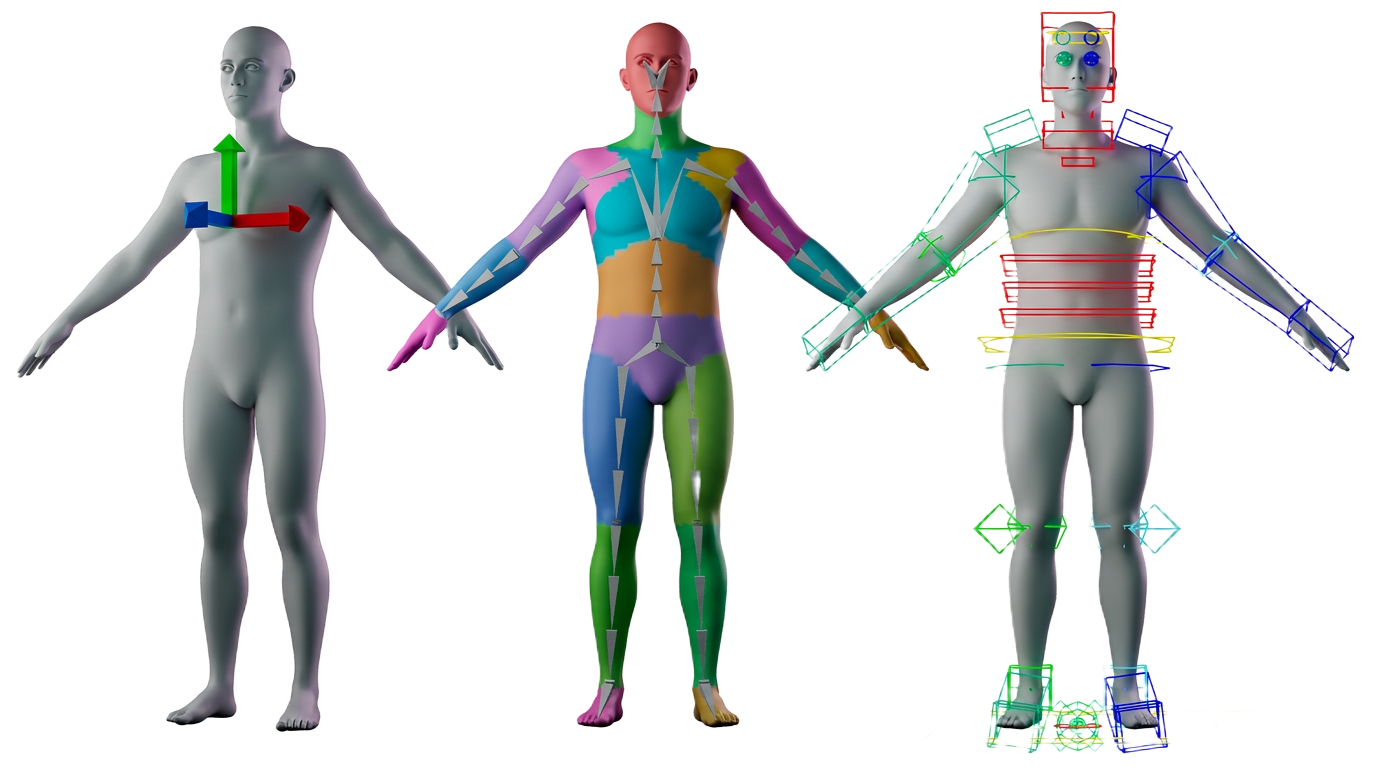
Character production involves many specialized, interdependent tasks—analysis, rig construction, skinning, deformation testing, corrective work, validation, and iteration.
Cerberus reorganizes those tasks into a coordinated system that combines deterministic DCC tooling, intelligent orchestration, automated evaluation, distributed processing, and artist-directed review.
What this demonstrates: complex CG workflows can be automated without turning them into opaque black boxes or removing artists from the decisions that matter.
Built and tested hands-on in real DCC workflows.
What this approach enables
- Less repetitive technical setup
Automate analysis, setup, and routine production work so specialists can focus on quality.
- Artists stay focused on judgment
Surface creative and quality decisions to the artist while routine execution happens in the background.
- Complex workflows become coordinated systems
Break large production tasks into specialized stages that can analyze, execute, evaluate, and refine work.
- Results stay editable and production-friendly
Use deterministic DCC tooling underneath the AI so outputs remain understandable, inspectable, and controllable.
- Technical iteration can scale
Distribute evaluation and refinement work across workers rather than requiring one artist to manually drive every step.
- Human review remains part of the system
Escalate ambiguity, taste, and high-risk decisions to the artist or supervisor instead of pretending every case can be fully automated.
Built with: computer vision, Maya automation, layered skinning, deformation evaluation, corrective refinement, distributed workers, and human-in-the-loop review.
(g) Example problems
Asset migration and conversion
Automating repetitive work involved in moving legacy assets into modern game or production pipelines.
Character and rigging workflows
AI-assisted analysis, rigging, skinning, deformation QA, corrective workflows, and character pipeline automation.
Production QA
Combining deterministic rules with AI-assisted visual or semantic checks to surface exceptions before they become downstream problems.
Agentic technical workflows
Breaking complex production tasks into bounded analysis, execution, and evaluation stages with human approval where it matters.
Knowledge and pipeline assistance
Helping artists and technical teams access documentation, tools, and production knowledge through secure AI-assisted interfaces.
(h) How engagements work
Talk with the people doing the work and observe the real production process.
Quantify time, repetition, errors, handoffs, and constraints.
Build a focused POC with clear evaluation criteria.
Integrate successful workflows into the production environment with the right security, monitoring, access, and user experience.
Help the team adopt the workflow and improve it based on real use.
(i) Why Vertex Theory
Built from production experience, not AI hype.
Vertex Theory was founded by Jeff Brodsky, a technical artist and rigging/pipeline specialist with more than 25 years of experience across feature animation, AAA games, VFX, real-time, and R&D. His work has spanned studios and organizations including Disney, Blue Sky Studios, Digital Domain, Blizzard Entertainment, Magic Leap, and Netflix.
Recent R&D has focused on a new production model: combining deterministic pipeline tooling with intelligent orchestration, multimodal perception, automated evaluation, distributed processing, and artist-directed refinement. The goal is not to remove artists from the process—it is to remove the repetitive technical work around them.
Experience includes







- 25+ years professional CG production
- Deep character / deformation / pipeline expertise
- Maya, real-time, and technical art experience
- Intelligent orchestration + deterministic production systems
- Artist-first UX and workflow design
- Human-in-the-loop evaluation and control
- Hands-on AI systems development
Explore what production could look like next.
Whether you're investigating a specific bottleneck, rethinking an existing workflow, or figuring out where AI belongs in your production stack, let's start with the way your team actually works.